
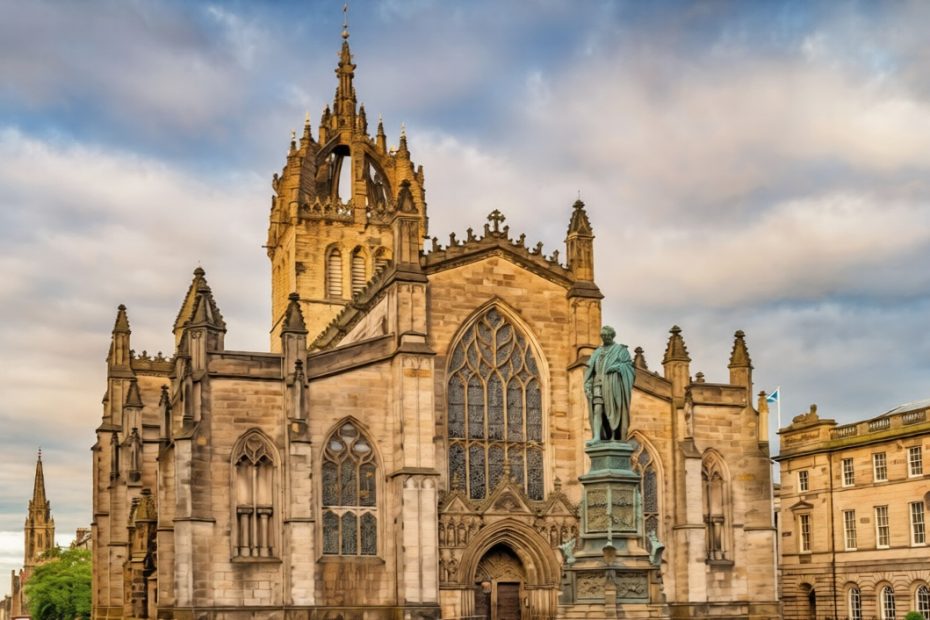
Standing proudly on the Royal Mile in the historic centre of Edinburgh, St Giles’ Cathedral is one of the most significant religious and historical buildings in Scotland. Often called the “High Kirk of Edinburgh,” the church has served the city for more than nine centuries and has been the stage for many of the most dramatic episodes in Scottish history.
Although commonly known as a cathedral, St Giles’ is technically not a cathedral in the modern sense because it does not house a bishop’s seat. Instead, it is the central church of the Church of Scotland, and historically it has been associated with the rise of Presbyterianism during the Scottish Reformation.
Today, St Giles’ Cathedral Edinburgh functions both as an active place of worship and as a cultural landmark visited by hundreds of thousands of tourists each year. Its crown-shaped tower dominates the skyline of the Old Town, while its interior contains extraordinary architecture, memorials, carvings, stained glass, and hidden symbolic elements that reveal centuries of Scottish history.
This best guide for St Giles Cathedral Edinburgh explores:
- The full medieval timeline of St Giles’ Cathedral Edinburgh
- The building’s architecture and design evolution
- Hidden symbols, carvings, and artworks
- Its role in Scottish politics and religion
- Its continuing role in national ceremonies
- And how easy it is to travel there from Barony House Edinburgh
Contents:
The Origins of St Giles’ Cathedral Edinburgh
Early Religious Site (Before 1124)
Although the official foundation date of St Giles’ Cathedral Edinburgh is 1124, archaeological and historical research suggests that the site may have been used for religious purposes even earlier.
Some historians believe a small church or shrine may have existed on the site before the Norman-style building constructed under the Scottish monarchy. This early religious structure may have been associated with early Christian communities in the region.
Regardless of whether a church existed earlier, the recognised foundation of St Giles’ Cathedral Edinburgh occurred during the reign of David I of Scotland, one of Scotland’s most influential medieval monarchs.
Foundation by King David I (1124)
King David I founded St Giles’ Cathedral Edinburgh in 1124, during a period when Scotland was becoming increasingly connected with European religious institutions.
David I promoted church reform and founded numerous monasteries and churches across Scotland. His aim was to modernise Scottish religious institutions and strengthen ties with the Roman Catholic Church.
At the time, Edinburgh was just beginning to develop into an organised settlement centred around Edinburgh Castle. The church was located near the eastern edge of the town and would later become central to the growing city.
The church was dedicated to Saint Giles, a saint widely venerated across medieval Europe.
Saint Giles was associated with:
- protection for the poor
- healing
- charity
- refuge for the vulnerable
Because of his popularity, many churches across Europe were dedicated to him.
The Medieval Timeline of St Giles’ Cathedral Edinburgh
12th Century: Romanesque Church
The earliest version of St Giles’ Cathedral Edinburgh was likely a Romanesque church, typical of Norman architecture introduced into Scotland during the medieval period.
Romanesque churches usually featured:
- thick stone walls
- rounded arches
- small windows
- simple decoration
Fragments of this early structure may still survive within the foundations and central pillars of the current building.
1243 – Consecration of the Church
Although the church had existed for over a century, St Giles’ Cathedral Edinburgh was officially consecrated on 6 October 1243 by David de Bernham, Bishop of St Andrews.
This ceremony likely reaffirmed the church’s status after earlier records of its consecration had been lost.
By the 13th century, St Giles’ had already become the principal parish church of Edinburgh.
1322 – English Attack
During the First War of Scottish Independence, English troops led by Edward II of England attacked parts of Edinburgh.
Historical sources suggest that St Giles’ Cathedral Edinburgh may have been damaged during this raid.
This was not the last time the church would suffer damage during Anglo-Scottish conflicts.
1384–1385 – Political Intrigue and Destruction
In 1384, Scottish nobles secretly met inside St Giles’ Cathedral Edinburgh with French envoys to discuss military plans against England.
The meeting took place as part of the Auld Alliance, a long-standing alliance between Scotland and France against England.
When Richard II of England discovered the plot, he retaliated by invading Scotland.
In 1385, English forces attacked Edinburgh and burned parts of the city, including St Giles’ Cathedral Edinburgh.
Scorch marks from the fire reportedly remained visible on the stone pillars of the cathedral for centuries afterward.
14th–15th Centuries: Gothic Reconstruction
After the fire, St Giles’ Cathedral Edinburgh underwent a major rebuilding programme.
The church was reconstructed in Gothic architectural style, replacing the earlier Romanesque structure.
Key Gothic features included:
- tall pointed arches
- ribbed vault ceilings
- large stained-glass windows
- flying buttresses
Much of the current structure dates from this reconstruction period.
By 1387, new chapels were already being added to the building.
1466 – Collegiate Church
In 1466, St Giles’ Cathedral Edinburgh became a collegiate church after the city petitioned the Pope for the change.
This meant the church was served by a group of clergy rather than a single priest.
The new status increased the church’s prestige and brought greater funding and influence.
The Crown Spire of St Giles’ Cathedral Edinburgh
One of the most famous features of St Giles’ Cathedral Edinburgh is its crown-shaped tower.
The crown spire was likely completed around the late 15th century and became a distinctive architectural symbol of the city.
The structure consists of:
- eight curved flying buttresses
- an open crown-like design
- a central lantern structure
This design is extremely rare and has become one of the defining features of the Edinburgh skyline.
Many visitors first notice the crown spire when viewing the Old Town from Calton Hill or Edinburgh Castle.
The Scottish Reformation and St Giles’ Cathedral Edinburgh
The Rise of Protestantism
The 16th century brought enormous change to Scotland.
The Scottish Reformation transformed the country from Roman Catholicism to Protestantism.
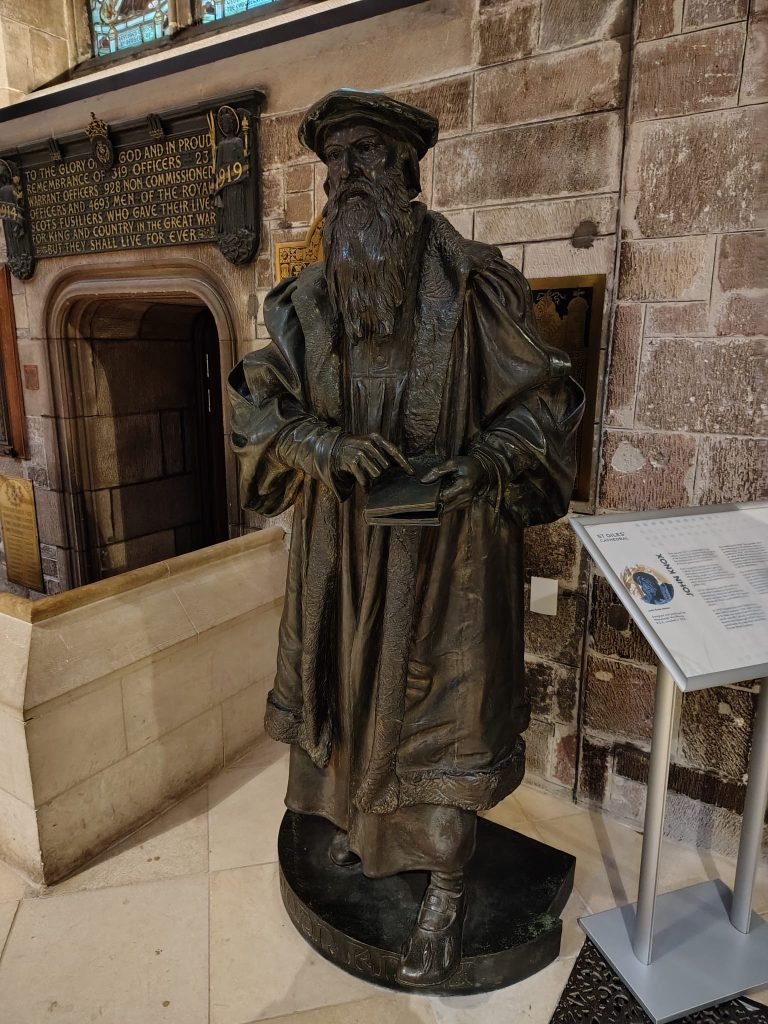
At the centre of this movement stood John Knox, whose preaching helped establish Presbyterianism.
John Knox at St Giles’
John Knox became minister at St Giles’ Cathedral Edinburgh in 1559.
From the pulpit of the church he delivered sermons advocating for:
- Protestant theology
- opposition to Catholic practices
- church governance independent from bishops
Because of Knox’s influence, St Giles’ became known as the “Mother Church of Presbyterianism.”
The Famous Riot of 1637
One of the most dramatic moments in the history of St Giles’ Cathedral Edinburgh occurred on 23 July 1637.
When the English-style prayer book was introduced into the church under Charles I of England, many Scottish Presbyterians objected.
According to legend, a woman named Jenny Geddes threw a stool at the minister.
The incident sparked riots and eventually led to the signing of the National Covenant, which rejected the king’s attempt to impose Anglican worship.
These events helped trigger the Wars of the Three Kingdoms in the mid-17th century.
Four Churches in One Building
During the late 16th and 17th centuries, St Giles’ Cathedral Edinburgh underwent one of the strangest transformations in its history.
The interior was divided into four separate churches serving different congregations.
These included:
- East Kirk
- Old or Great Kirk
- Tolbooth Kirk
- Haddo’s Hole Kirk
Stone partitions were constructed inside the building to divide the space.
For more than a century, four congregations worshipped simultaneously inside the same structure.
Victorian Restoration
By the 19th century, the cathedral had become heavily altered and somewhat neglected.
A major restoration began in 1872, led by Edinburgh’s Lord Provost William Chambers.
The project aimed to restore St Giles’ Cathedral Edinburgh to a unified medieval-style church.
Restoration work included:
- removing internal partitions
- cleaning centuries of soot
- restoring the pillars
- installing decorative floor tiles
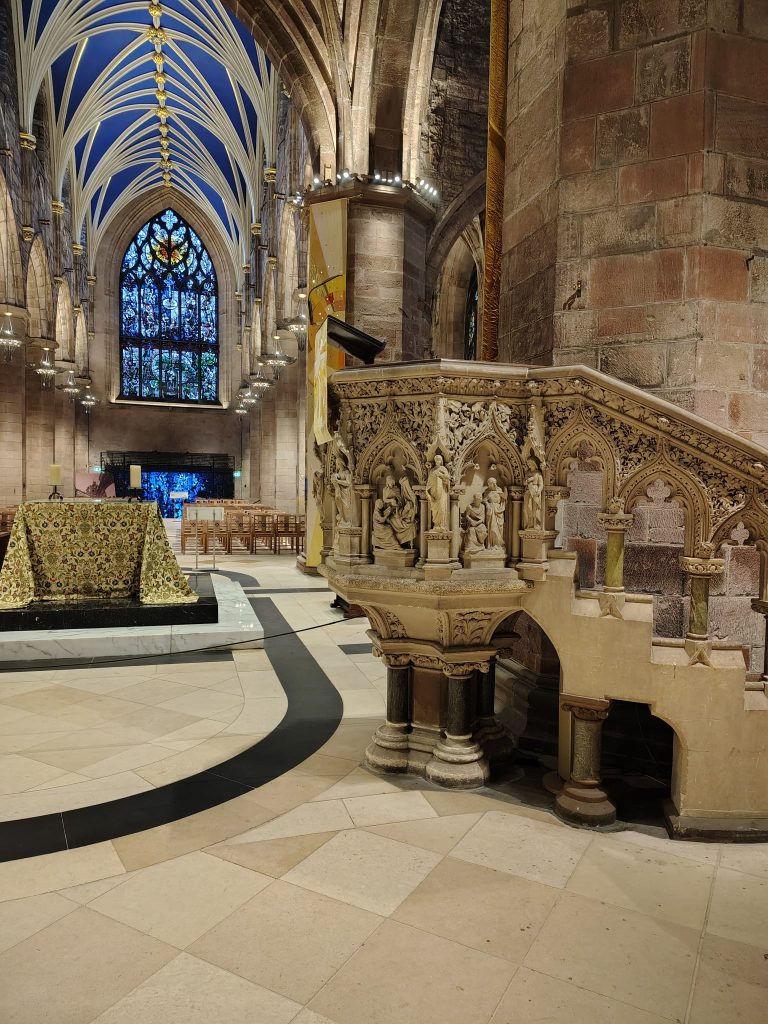
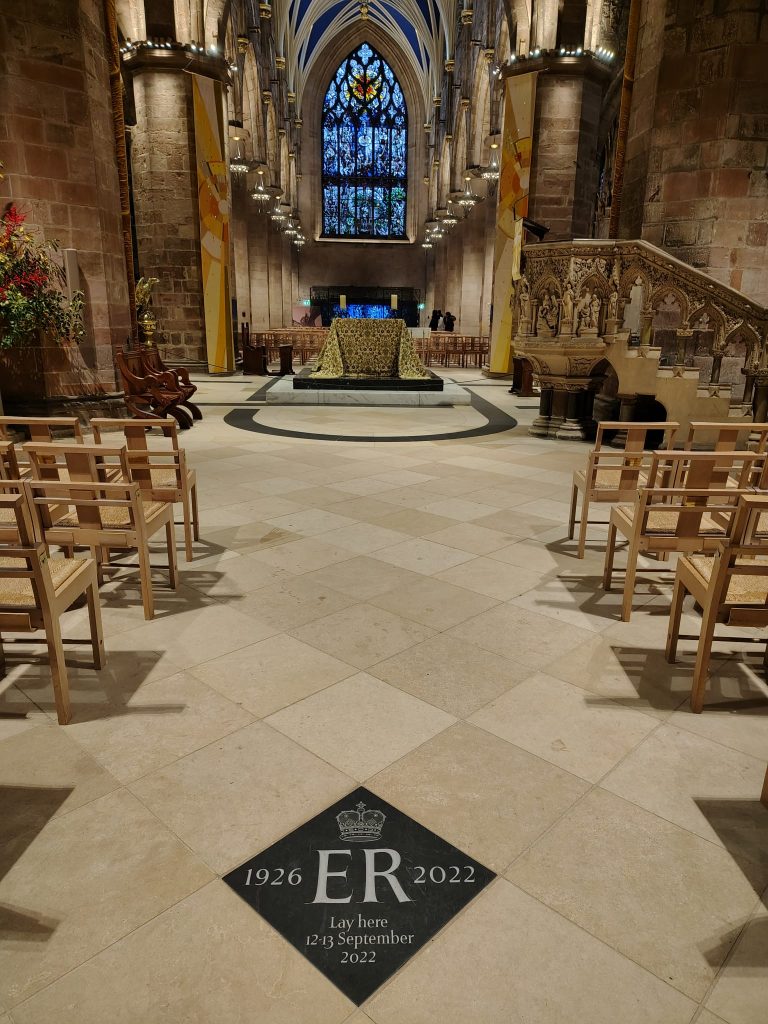
These renovations created the grand open interior seen today.
The Thistle Chapel
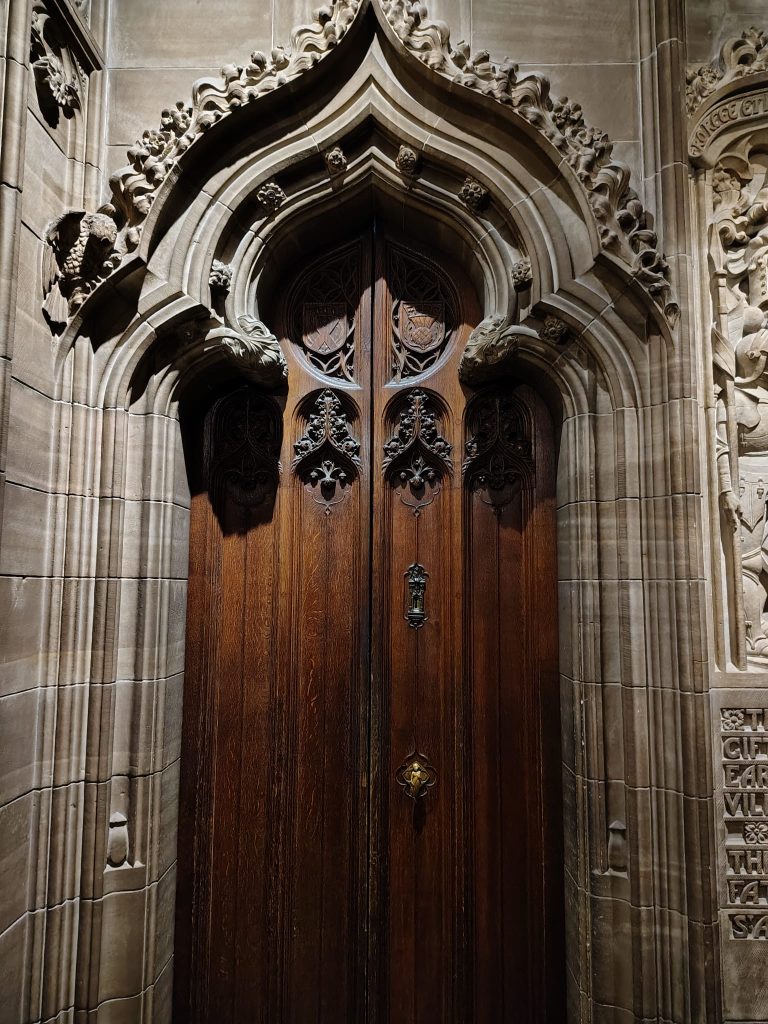
One of the most beautiful spaces inside St Giles’ Cathedral Edinburgh is the Thistle Chapel.
Completed in 1911, the chapel was designed by architect Robert Lorimer.
It serves as the ceremonial chapel of the Order of the Thistle.
Artistic Details
The chapel contains extraordinary craftsmanship including:
- carved oak stalls for knights
- heraldic banners
- intricate stone ceilings
- carved animals and plants
One of the most famous carvings is an angel playing bagpipes, a humorous yet iconic symbol of Scottish culture.
Hidden Symbols in St Giles’ Cathedral Edinburgh
St Giles’ Cathedral Edinburgh contains numerous symbolic carvings and decorations.
These hidden details often go unnoticed by casual visitors.
Examples include:
1. The Unicorn
The unicorn appears in several carvings inside the cathedral.
It is the national animal of Scotland and symbolises purity and strength.
2. Angels with Musical Instruments
In the Thistle Chapel and elsewhere, angels are depicted playing instruments.
One carving shows an angel playing the bagpipes.
3. Heraldic Shields
Many shields represent Scottish clans and members of the Order of the Thistle.
4. Floral Carvings
The thistle flower appears repeatedly as a symbol of Scotland.
The Interior Architecture
The architecture of St Giles’ Cathedral Edinburgh reflects multiple historical periods.
Key elements include:
The Nave
The nave contains massive stone pillars supporting the vaulted ceiling.
These pillars date from the medieval reconstruction following the 14th-century fires.
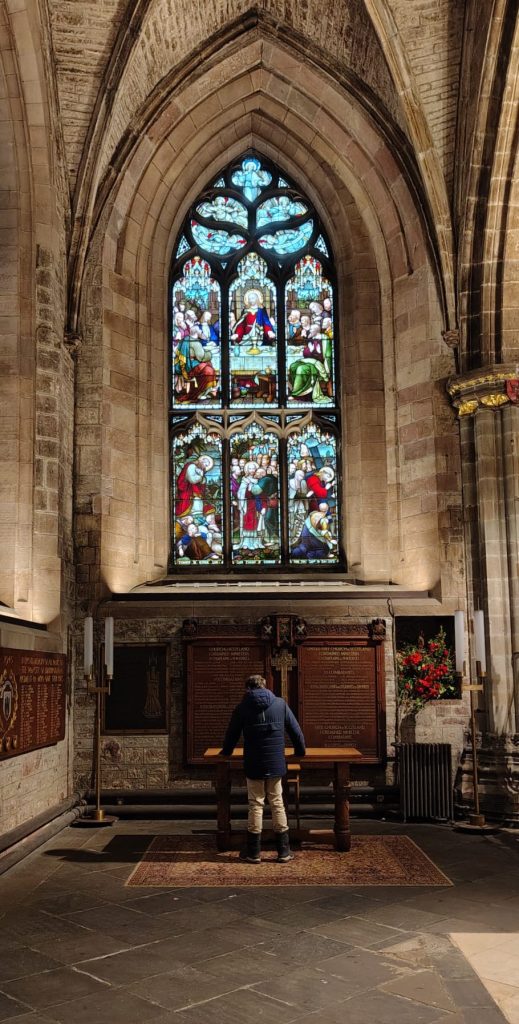
Stained Glass
Many of the stained glass windows date from the 19th and 20th centuries.
One famous window honours Robert Burns.
The Organ of St Giles’ Cathedral
The organ in St Giles’ Cathedral is one of the most impressive musical instruments in Scotland and plays a central role in the cathedral’s worship services, concerts, and ceremonial occasions. Over the centuries the instrument has evolved through several versions, reflecting changes in musical style, church practice, and organ-building technology. The current organ, installed in the late twentieth century, represents a modern interpretation of the cathedral organ tradition while preserving the rich musical heritage associated with St Giles’.
Early History of the Organ
The presence of an organ forms a strong centre piece for St Giles Cathedral Edinburgh History and dates back several centuries, although the earliest instruments were much smaller and simpler than the one used today. During the medieval period, organs were commonly used in large European churches to accompany choral music and enhance liturgical ceremonies. However, during the Scottish Reformation in the 16th century, organs fell out of favour in many Scottish churches. Protestant reformers often preferred simpler styles of worship without elaborate musical accompaniment, and many church organs were removed or destroyed.
As a result, St Giles’ Cathedral went for a long period without a permanent organ. Musical worship relied mainly on congregational singing and psalm chanting rather than instrumental accompaniment.
The Return of the Organ
In the nineteenth century, attitudes toward church music began to change. As part of the broader Victorian revival of church architecture and liturgy, organs were reintroduced into many churches across Britain. When St Giles’ Cathedral underwent major restoration work in the 1800s, plans were made to reinstall an organ suitable for the cathedral’s renewed role as a national religious landmark.
Several organs were installed during the nineteenth and early twentieth centuries, each larger and more sophisticated than the previous one. These instruments accompanied the cathedral’s growing choral tradition and supported increasingly elaborate musical performances during services and public events.
The Modern Rieger Organ
The current organ in St Giles’ Cathedral was built by the Austrian organ-building company Rieger Orgelbau and installed in 1992. This modern instrument replaced an earlier twentieth-century organ and was designed specifically for the cathedral’s acoustics and architectural layout.
The Rieger organ is notable for its clarity, power, and versatility. It contains over 4,000 pipes, which vary in size from small pipes only a few centimetres long to large pipes several metres in height. These pipes produce a wide range of tones and musical colours, allowing the organ to perform everything from quiet meditative pieces to powerful symphonic works.
The instrument includes multiple manuals (keyboards) and a pedal board played with the organist’s feet. Each keyboard controls different groups of pipes, enabling the organist to combine sounds in complex ways and create a rich musical texture.
Role in Worship and Concerts
The organ plays an essential role in the musical life of St Giles Cathedral Edinburgh Scotland. It accompanies the cathedral choir during services, supports congregational hymn singing, and is used for weddings, memorials, and national ceremonies. Because St Giles’ is considered the “High Kirk” of Edinburgh, many important civic and religious events include organ music.
The cathedral also hosts regular organ recitals and concerts. These performances attract organists from around the world who come to play the instrument and take advantage of the building’s remarkable acoustics. The high vaulted ceilings and stone interior of St Giles’ Cathedral create a resonant environment that enhances the organ’s sound, filling the entire space with music.
Musical and Cultural Significance
Today the organ of St Giles Cathedral Scotland represents both tradition and innovation. It connects modern worship with centuries of musical history while providing a powerful instrument capable of performing a wide repertoire of sacred and classical music. For visitors, hearing the organ played inside the cathedral is often one of the most memorable experiences of a visit to St Giles’, demonstrating how music continues to bring life and atmosphere to this historic building.
Whats On St Giles Cathedral Edinburgh Today
Today the cathedral functions as:
- an active church
- a historical monument
- a cultural venue
It hosts:
- daily prayer services
- concerts
- national memorial services
- ceremonies such as the Kirking of the Parliament
Getting to St Giles’ Cathedral Edinburgh from Barony House
Visitors staying at Barony House will find it extremely easy to reach St Giles’ Cathedral Edinburgh.
Barony House is located in the Newington area of Edinburgh, south of the Old Town.
Walking Route
The walk from Barony House to St Giles’ Cathedral Edinburgh is a most pleasant experience.
Typical walking time: 20–30 minutes.
A common route is:
- Walk north along Mayfield Gardens.
- Continue along Nicolson Street.
- Reach South Bridge.
- Turn onto the Royal Mile.
The cathedral stands prominently along the High Street.
Bus Routes
Several buses run from Newington to the city centre.
The journey usually takes 10–15 minutes.
Most buses stop near:
- North Bridge
- South Bridge
Both locations are only a short walk from St Giles’ Cathedral Edinburgh.
Taxi
A taxi from Barony House to St Giles’ Cathedral Edinburgh typically takes 5–10 minutes.
This is one of the quickest and most convenient options.
Why St Giles’ Cathedral Edinburgh Matters
St Giles’ Cathedral Edinburgh is important because it represents nearly 900 years of Scottish history.
The church has been:
- a centre of medieval worship
- the focal point of the Scottish Reformation
- a venue for national ceremonies
- an architectural landmark
It is also one of the most photographed buildings in Edinburgh.
Conclusion
For nearly nine centuries, St Giles’ Cathedral has stood at the heart of Edinburgh’s history.
From its founding in 1124 by King David I to its role in the Scottish Reformation, the cathedral has witnessed some of the most important moments in Scotland’s past. Fires, wars, religious upheaval, and architectural transformations have all shaped the building that stands today.
Its crown-shaped spire, intricate Gothic architecture, hidden carvings, and magnificent Thistle Chapel make St Giles’ Cathedral Edinburgh one of the most remarkable churches in the United Kingdom.
For visitors staying at Barony House, the cathedral is also very easy to reach. A pleasant walk, short bus journey, or quick taxi ride brings you directly to the Royal Mile, where nearly a thousand years of Scottish history await.